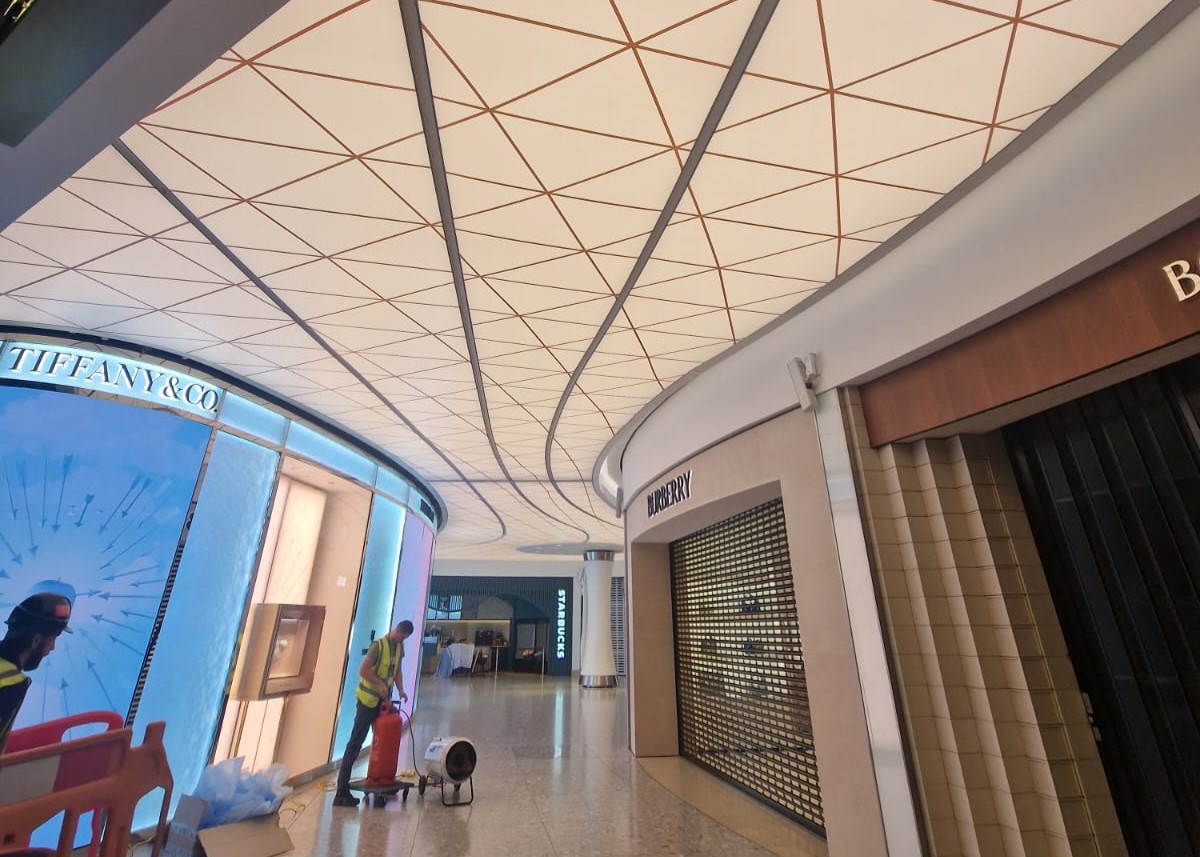
Acoustic Stretch Ceilings: How They Work and Where They Make Sense
An acoustic stretch ceiling tackles the problem at the largest surface in the room, without changing how the ceiling looks.
Modern interiors are full of hard surfaces. Glass partitions, exposed concrete, polished floors and plaster ceilings all reflect sound, which is why so many new offices, restaurants and open-plan homes feel noisy and echoey. An acoustic stretch ceiling tackles the problem at the largest surface in the room, without changing how the ceiling looks.
Why Rooms Echo
Sound bounces off hard surfaces. In a room with few soft finishes, it keeps reflecting, so conversations overlap, voices carry and meetings become tiring. This is called reverberation. The fix is to add surfaces that absorb sound instead of reflecting it, and the ceiling is usually the biggest uninterrupted area available.
How an Acoustic Stretch Ceiling Works
An acoustic stretch ceiling uses the same perimeter track and tensioned membrane as a standard stretch ceiling, with two differences:
- The membrane lets sound through. Acoustic membranes are either fabric or micro-perforated, so sound passes into the ceiling void instead of bouncing back into the room.
- The void absorbs it. An absorbent layer behind the membrane soaks up the sound energy, reducing echo in the room below.
From normal viewing distance, the ceiling still reads as a smooth, seamless surface.
Fabric or PVC for Acoustics?
At Imperial, cold-stretch fabric is our premium choice for acoustic projects. It gives a seamless matt finish, is lightweight, fire-rated to B-s1,d0, and suits high-end residential interiors and commercial offices.
Hot-stretch PVC remains the right specification where moisture is the priority, such as pools and wet rooms. If you need both moisture resistance and echo control, talk to us about the best combination for your space. Read our guide to hot vs cold stretch ceilings
Where Acoustic Stretch Ceilings Make Sense
Open-plan offices and meeting rooms: Glass meeting rooms and open floors are some of the worst spaces for echo. An acoustic ceiling makes calls and meetings clearer without adding bulky panels.
Restaurants and bars: Diners leave noisy restaurants. Reducing reverberation lets people talk at a normal volume, while the ceiling keeps a clean finish.
Home cinemas and media rooms: Controlling reflections improves sound clarity, and acoustic fabric can be combined with fibre optic star effects.
Receptions, galleries and leisure spaces: Large, hard-finished spaces benefit most from treating the ceiling as one continuous absorbent surface.
Installation and Guarantee
Every panel is made to the exact dimensions of your space and clipped into a perimeter track. Installation is fast, clean and dry, with no wet trades, which makes it well suited to retrofits in occupied buildings. Every installation carries our 10-year guarantee and is fitted by CSCS-qualified operatives.
Acoustic Stretch Ceiling FAQs
Will an acoustic ceiling stop noise from upstairs or next door?
No. Acoustic ceilings absorb sound within a room to reduce echo. Stopping sound passing between rooms is soundproofing, which needs mass and separation in the building structure.
Does an acoustic stretch ceiling look different from a standard one?
From normal viewing distance it looks like a smooth, seamless ceiling.
Is an acoustic stretch ceiling more expensive?
Usually, yes. The absorbent layer and membrane add to the cost of a standard system. Price depends on size, shape, cut-outs and any lighting. Contact us for a free estimate.
Can it be fitted to an existing room?
Yes. Stretch ceilings fit below the existing ceiling, so they work for refurbishments as well as new builds.
Can You Still Have Lights, Speakers and Sprinklers?
Yes. We create apertures for downlights, speakers, grilles and smoke heads, just as in a plasterboard ceiling. Fittings need to be self-supported.